Last year, a marketing manager told me her team sent 15,000 emails monthly but couldn’t explain which messages actually drove revenue. They’d built complex automation workflows over three years, layering triggers and conditions until nobody understood what fired when or why. The result? Subscribers received duplicate messages, contradictory offers, and perfectly timed emails arriving days too late.
After auditing their setup, we discovered 40% of workflows were broken or outdated, 30% duplicated each other, and the remaining 30% actually worked—but nobody knew which ones. We rebuilt from scratch using simple principles that transformed chaos into predictable revenue.
Email automation workflows done right feel like magic to recipients—perfectly timed messages that anticipate needs and deliver value precisely when helpful. Done wrong, they create spam folders full of irrelevant noise that trains customers to ignore your brand. The difference isn’t expensive software or advanced AI—it’s thoughtful strategy and disciplined execution.
In this guide, I’m sharing the step-by-step process for building email workflows that actually work, based on campaigns that have generated millions in revenue across dozens of industries.
What Makes an Effective Email Workflow?
Effective workflows automate repetitive communication while maintaining the personal touch that builds relationships. They respond to specific customer actions or conditions with relevant messages that move recipients toward desired outcomes—whether that’s making a purchase, booking a demo, or re-engaging after inactivity.
Clear triggers based on specific behaviors or data points ensure emails arrive at logical moments. Relevant content addresses the recipient’s current situation rather than following generic templates. Appropriate timing respects natural decision-making processes without overwhelming subscribers. Measurable outcomes tied to business goals enable optimization based on actual performance rather than assumptions.
These principles integrate seamlessly with broader AI-powered CRM and email automation strategies that leverage unified customer data for sophisticated personalization at scale.
7 Essential Email Workflows Every Business Needs
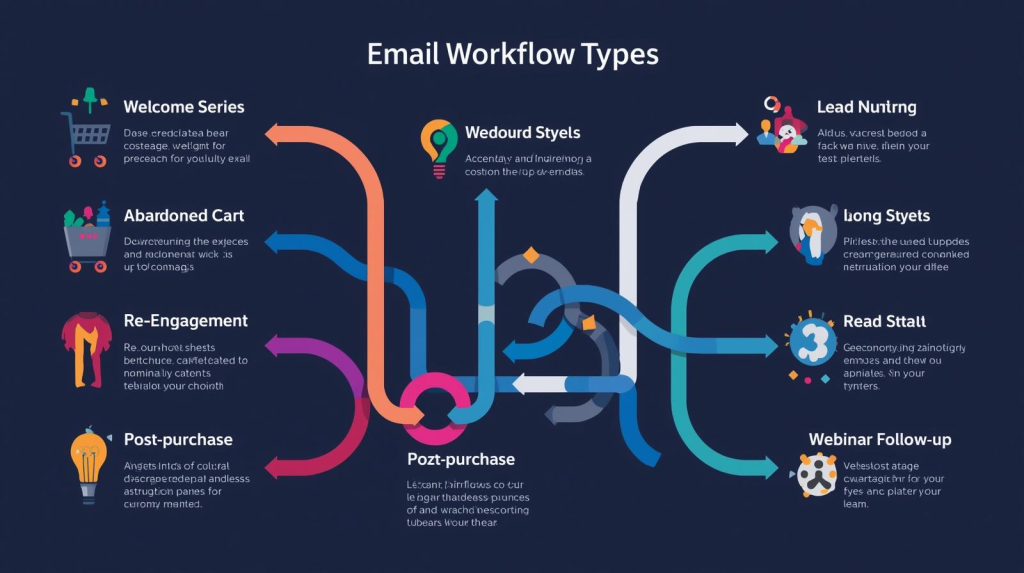
1. Welcome Series for New Subscribers
Welcome emails generate 320% more revenue per email than promotional messages because they reach subscribers at peak engagement. New subscribers expect immediate acknowledgment and want to understand what value your emails will provide.
Workflow Structure:
- Email 1 (Immediate): Thank them for subscribing, set expectations about email frequency, deliver promised lead magnet
- Email 2 (Day 2-3): Share your brand story, mission, or unique value proposition
- Email 3 (Day 4-5): Showcase social proof through testimonials, case studies, or popular content
- Email 4 (Day 7+): Segment based on initial engagement and send targeted follow-up content
Performance Metrics: Open rates (60-80% on Email 1), click-through rates, first purchase conversion (10-15%), unsubscribe rates.
2. Abandoned Cart Recovery
Ten to fifteen percent of abandoned carts can be recovered through automated reminders. Customers abandon carts for many reasons—comparison shopping, unexpected shipping costs, distraction—but gentle nudges often bring them back.
Workflow Structure:
- Email 1 (1 hour after abandonment): Simple reminder showing cart contents, easy one-click return
- Email 2 (24 hours): Address common objections (free shipping, easy returns, security guarantees)
- Email 3 (48-72 hours): Offer incentive (10% discount, free shipping) to close the deal
Performance Metrics: Cart recovery rate (10-15%), revenue recovered, email open rates (40-50%).
Abandoned cart workflows demonstrate how email automation tools transform one-time manual outreach into systematic revenue recovery running 24/7.
3. Lead Nurturing Drip Campaign
Lead nurturing workflows convert 5-15% of cold leads into sales opportunities by building trust over time. B2B buyers typically require 7-13 touches before making purchase decisions, and automated nurturing delivers those touches systematically.
Workflow Structure:
- Email 1: Educational content addressing primary pain points
- Email 2: Case study or success story demonstrating results
- Email 3: Product/service overview explaining how you solve problems
- Email 4: Social proof, testimonials, or industry recognition
- Email 5: Demo offer or consultation invitation
Performance Metrics: Lead-to-opportunity conversion (5-15%), email engagement rates, qualified lead increase (20-30%).
4. Re-engagement Campaign for Inactive Subscribers
Re-engagement campaigns reactivate 5-12% of dormant subscribers and cost 5-10x less than acquiring new contacts. They also improve list hygiene by identifying truly uninterested recipients who should be removed.
Workflow Structure:
- Email 1 (After 90 days inactivity): “We miss you” message asking if they still want emails
- Email 2 (7 days later): Highlight what they’ve missed, showcase popular content or products
- Email 3 (14 days later): Special incentive to re-engage, final chance before removal
Performance Metrics: Reactivation rate (12-18%), list churn reduction, engagement improvement.
5. Post-Purchase Follow-Up Sequence
Post-purchase emails generate 60-80% open rates and increase customer lifetime value by 25-30% through repeat purchases and referrals. They reduce support tickets by proactively addressing common questions and build loyalty through continued engagement.
Workflow Structure:
- Email 1 (Immediate): Order confirmation with delivery tracking
- Email 2 (Delivery day): Usage tips, setup guides, or getting-started resources
- Email 3 (7 days post-delivery): Request review or feedback
- Email 4 (14-30 days): Cross-sell complementary products, loyalty program invitation
Performance Metrics: Open rates (60-80%), repeat purchase rate (+25-30%), support ticket reduction, review collection rate.
6. Birthday and Anniversary Campaigns
Personalized occasion emails generate 342% higher revenue per email than standard promotional messages. They create emotional connections while providing natural reasons to offer special deals without training customers to wait for discounts.
Workflow Structure:
- Email (Birthday/Anniversary): Personal message, exclusive offer, limited-time incentive
Performance Metrics: Redemption rates (15-25%), emotional connection indicators, incremental revenue.
7. Webinar Registration and Follow-Up
Webinar workflows maximize attendance and convert registrants into opportunities. Only 30-40% of registrants typically attend live, so follow-up sequences with recordings capture the remaining 60-70%.
Workflow Structure:
- Email 1 (Registration confirmation): Calendar invite, what to expect, preparation tips
- Email 2 (1 day before): Reminder with login details
- Email 3 (1 hour before): Final reminder
- Email 4 (No-shows): Recording link, key takeaways, next steps
- Email 5 (All registrants): Related resources, consultation offer, implementation guidanceu
Performance Metrics: Attendance rate (30-40%), recording views, conversion from webinar to qualified lead.
Building Your Workflow: Step-by-Step Process
Step 1: Define Clear Goals and Target Audience
Start with specific, measurable objectives tied to business outcomes. Are you nurturing leads toward demos, driving repeat purchases, or reducing churn? Each goal requires different workflow design and messaging strategy.
Create detailed profiles of recipients considering demographics, behavior, purchase history, and current stage in customer journey. The more precisely you define your audience, the more relevant your messaging becomes.
Step 2: Map the Customer Journey
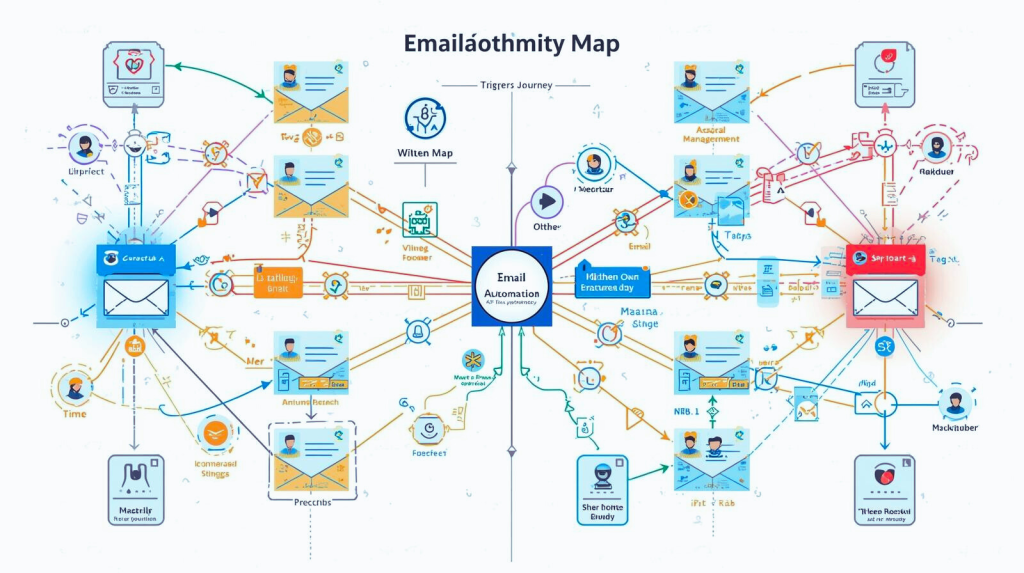
Document every touchpoint from initial awareness through purchase and beyond. Identify natural moments when automated communication adds value rather than annoyance—after signup, before cart abandonment, post-purchase, renewal time.
Visualize the journey as a flowchart showing decision points, possible paths, and desired outcomes at each stage. This mapping reveals workflow opportunities you might otherwise overlook.
Step 3: Segment Your Email List
Accurate segmentation ensures the right subscribers enter each workflow. Segment based on campaign-relevant objectives: past purchases for cross-sell campaigns, user activity for re-engagement, lead score for nurturing sequences.
Use marketing automation tools to dynamically segment lists, ensuring subscribers always land in the most relevant groups as their behavior changes. Static segments become outdated quickly and deliver increasingly irrelevant messages over time.
Connection to AI customer segmentation strategies enables sophisticated behavioral grouping that improves targeting without manual list management.
Step 4: Design Workflow Triggers and Conditions
Set triggers based on precise behaviors or conditions that signal readiness for specific messages. Common triggers include form submissions, website visits, email clicks, purchase completion, or time-based rules like “90 days since last purchase”.
Add conditional logic that branches workflows based on recipient responses. If someone clicks your demo link, skip remaining educational emails and move to sales follow-up. If they ignore three messages, exit them to a different nurture track.
Step 5: Craft Compelling Content and Timing
Write email copy that addresses the recipient’s current situation and provides genuine value. Every message should educate, solve problems, or entertain—not just push sales.
Determine optimal timing based on your industry and customer behavior. B2B audiences often respond better during business hours, while B2C engagement peaks evenings and weekends. Test different schedules to find what works for your specific audience.
Space emails appropriately to avoid overwhelming recipients. A welcome series might send daily for a week, while lead nurturing stretches over weeks or months.
Step 6: Implement in Your Automation Platform
Use email automation tools like HubSpot, ActiveCampaign, or Klaviyo to build workflows. Enter triggers, conditions, and actions according to your design. Leverage advanced segmentation features to ensure only appropriate subscribers enter each flow.
Configure proper entry and exit criteria so subscribers don’t get stuck in workflows after converting or unsubscribing. Test these boundaries thoroughly before going live.
Step 7: Test Thoroughly Before Launch
Run tests using test contacts to ensure triggers fire correctly, emails display properly, links work, and conditional splits behave as expected. Check that subscribers enter and exit workflows at correct points.
Send test emails to multiple devices and email clients to catch rendering issues before they reach customers. One broken link or formatting error undermines even the best strategy.
Step 8: Monitor, Measure, and Optimize
Track key performance metrics: open rates, click-through rates, conversion rates, unsubscribe rates, and revenue generated. Compare results against benchmarks and goals to identify underperforming workflows.
A/B test subject lines, email content, timing, and calls-to-action systematically. Small improvements compound over time—a 2% conversion increase on a workflow touching 10,000 subscribers monthly adds 200 conversions annually.
Schedule quarterly workflow audits to remove outdated sequences, update messaging, and incorporate learnings from successful campaigns.
Common Workflow Mistakes to Avoid
Over-automation creates impersonal experiences that feel robotic. Balance automation efficiency with human touchpoints at critical moments—particularly high-value opportunities or customer service issues requiring personalized attention.
Ignoring list hygiene means wasting resources sending to unengaged recipients who damage deliverability. Remove hard bounces immediately and sunset inactive subscribers after re-engagement attempts fail.
Generic messaging defeats the purpose of segmentation. If automated emails could apply to anyone, they won’t resonate with anyone. Use dynamic content, personalization tokens, and behavioral triggers to create relevance.
Setting and forgetting allows workflows to become outdated. Markets evolve, products change, and messaging grows stale. Schedule regular reviews ensuring workflows remain effective and aligned with current business priorities.
The Future of Email Workflow Automation
Email automation continues evolving toward true one-to-one personalization at scale. AI-powered systems increasingly predict optimal send times, subject lines, and content variations for individual recipients rather than segments.
Organizations combining sophisticated CRM integration with behavioral workflows create seamless experiences that feel personally crafted despite serving thousands of customers simultaneously. The teams winning in 2025 treat automation as strategic capability requiring continuous optimization rather than one-time setup projects.
The technology enabling effective workflows already exists and grows more accessible yearly. The question isn’t whether automation works—it’s how quickly you’ll implement it systematically before competitors gain the advantage.

A.G. Makoudi is a tech writer specializing in SaaS tools and digital solutions, helping readers simplify technology and make smarter software choices.