
Six months ago, a sales director confided something surprising: “Our reps spend 60% of their time chasing leads that will never close, while high-intent prospects sit ignored in the CRM.” His team used traditional lead scoring—assigning points for job titles, company size, and email opens. On paper, it looked scientific. In practice, it was guesswork dressed in spreadsheets.
After implementing predictive lead scoring, their conversion rates jumped 42% within three months. Not because reps suddenly became better sellers, but because they finally focused energy on leads actually ready to buy. The AI identified patterns invisible to human analysis, surfacing opportunities the old point system routinely missed.
Predictive lead scoring represents one of the most impactful applications of AI in sales—yet many teams still rely on outdated manual methods that waste time and miss revenue. In this guide, I’m explaining how predictive scoring works, why it outperforms traditional approaches, and how to implement it effectively without needing a data science degree.
What is Predictive Lead Scoring?
Predictive lead scoring uses machine learning algorithms to analyze historical data and identify which leads are most likely to convert based on patterns from past wins and losses. Instead of manually assigning point values to specific attributes, the AI examines hundreds of signals simultaneously—demographics, behavior, engagement patterns, firmographics—to calculate conversion probability.
The system continuously learns from outcomes, automatically adjusting scoring criteria as your market evolves and buyer behavior shifts. When deals close or leads go cold, the algorithm incorporates that feedback to improve future predictions without human intervention.
This approach integrates naturally with broader AI-powered CRM and email automation strategies that leverage unified customer data for smarter targeting across all touchpoints.
Traditional vs. Predictive Lead Scoring: The Critical Differences
Traditional lead scoring assigns predetermined point values to specific characteristics: +10 points for director-level title, +5 for email open, +15 for pricing page visit. Marketing and sales teams debate these values in conference rooms, making educated guesses about what signals matter most. The system remains static until someone manually updates the scoring rules—which rarely happens.
Predictive scoring flips this model entirely:
| Aspect | Traditional Scoring | Predictive Scoring |
|---|---|---|
| Method | Manual point assignment | Machine learning trained on outcomes |
| Data Sources | Limited (10-20 factors) | Extensive (100+ behavioral and demographic signals) |
| Accuracy | Assumption-based, subjective | Outcome-driven, empirically validated |
| Maintenance | Static, requires manual updates | Continuously learning and adapting |
| Scalability | Manual tuning per campaign | Fully automated and self-optimizing |
Traditional scoring says “We think pricing page visits matter.” Predictive scoring says “Our data proves pricing page visits from companies with 50-200 employees who also downloaded case studies convert at 67% compared to 12% baseline”.
The difference isn’t incremental—it’s transformational. Organizations implementing predictive scoring typically see 30-40% improvements in conversion rates and 25-35% reductions in sales cycle length.
How Predictive Lead Scoring Actually Works
Data Collection and Preparation
The AI engine ingests historical data from your CRM, marketing automation platform, website analytics, and any other systems tracking customer interactions. It needs both converted leads (closed-won deals) and unconverted leads (lost opportunities or cold prospects) to understand what differentiates success from failure.
Minimum data requirements typically include at least 100 converted leads and similar numbers of unconverted leads, though models improve significantly with 500+ examples in each category. The system analyzes demographic information (company size, industry, location), firmographics (revenue, growth rate, technology stack), and behavioral signals (website visits, content downloads, email engagement, social media interactions).
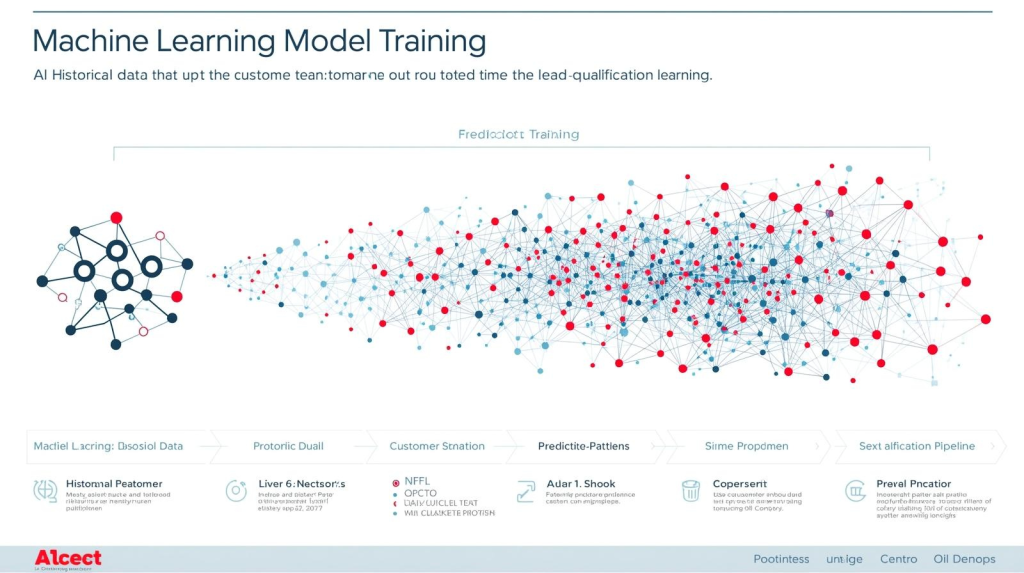
Pattern Recognition and Model Training
Machine learning algorithms identify patterns correlating with conversion outcomes. The AI might discover that leads from healthcare companies with 100-500 employees who visit your pricing page twice and download a case study within two weeks convert at 58%, while similar leads without the case study download convert at only 19%.
These patterns often surprise human analysts because they involve complex interactions between multiple factors rather than simple linear relationships. The algorithm tests thousands of potential patterns to identify genuine predictive signals versus random noise.
Score Generation and Ranking
Once trained, the model assigns each new lead a probability score—typically 0-100—representing their likelihood to convert based on similarity to past successful conversions. High scores indicate leads matching patterns of previous wins, while low scores flag prospects unlikely to close regardless of sales effort invested.
Sales teams receive ranked lead lists prioritizing outreach toward the highest-probability opportunities. This focus dramatically improves efficiency by directing limited resources toward leads actually ready to buy.
Continuous Learning and Refinement
As new outcomes occur, the system incorporates that feedback to refine predictions. If previously high-scoring leads fail to convert, the algorithm investigates why and adjusts scoring criteria accordingly. This continuous learning keeps the model accurate even as market conditions and buyer behavior evolve.
Key Benefits of Predictive Lead Scoring
Improved Sales Efficiency
Sales reps waste less time on low-quality leads and focus energy on high-probability opportunities. One B2B software company reduced sales cycle length by 30% simply by prioritizing predictive scores over manual qualification methods.
Teams achieve more with existing resources—no additional headcount required, just smarter allocation of effort toward leads actually worth pursuing.
Higher Conversion Rates
Predictive scoring identifies buying signals humans miss, surfacing ready-to-buy prospects that traditional methods overlook. Companies typically report 25-45% improvements in lead-to-opportunity conversion rates after implementing predictive models.
The AI recognizes complex patterns—like specific content consumption sequences or engagement timing—that strongly predict purchase intent but would never appear in manual scoring rubrics.
Better Marketing ROI
Marketing teams optimize campaigns and budget allocation based on which channels and tactics generate the highest-scoring leads. Instead of tracking vanity metrics like form fills or downloads, they focus on lead quality measured by conversion probability.
This shift typically improves marketing ROI by 20-35% as budgets move away from volume-focused channels toward quality-focused strategies.
Alignment Between Sales and Marketing
Predictive scoring creates objective, data-driven lead quality definitions that both teams accept. No more arguments about whether marketing delivers “good leads”—the AI provides neutral assessment based on conversion likelihood.
This alignment accelerates handoffs and improves follow-up because sales trusts that high-scoring leads genuinely merit immediate attention.
Implementing Predictive Lead Scoring: A Practical Framework
Step 1: Audit Your Data Quality
Predictive models require clean, complete historical data to generate accurate predictions. Audit your CRM for missing information, duplicate records, and inconsistent data entry. Establish data governance processes ensuring future information remains reliable.
Most implementation failures trace back to poor data quality—garbage in, garbage out applies doubly to machine learning systems. Invest time cleaning your data foundation before building predictive models on top.
Step 2: Define Clear Goals and Success Metrics
Establish specific objectives: increase conversion rates by 25%, reduce sales cycle by 20 days, or improve sales efficiency by 30%. Define what constitutes a “qualified lead” in your organization and identify the business outcomes you’re optimizing toward.
Set measurable KPIs tracking scoring effectiveness: prediction accuracy, conversion rate improvements, sales cycle reduction, and rep productivity gains. These metrics guide implementation decisions and prove ROI to stakeholders.
Step 3: Choose Your Predictive Scoring Platform
Multiple solutions offer predictive lead scoring with different approaches:
- Salesforce Einstein delivers deep CRM integration for enterprise organizations already committed to Salesforce
- HubSpot Predictive Lead Scoring provides accessible AI for mid-market companies using HubSpot Marketing Hub Professional or Enterprise tiers
- Microsoft Dynamics 365 includes predictive scoring for organizations in the Microsoft ecosystem
- Marketo offers sophisticated scoring for marketing automation-focused teams
- Standalone tools like 6sense, MadKudu, or Clearbit integrate with various CRM and marketing platforms
Select platforms that integrate easily with your existing technology stack and align with your budget and technical capabilities. Most offer trial periods—test with real data before committing.
Step 4: Pilot with a Lead Subset
Start with a controlled pilot targeting specific lead segments or sales teams rather than full deployment. Track performance metrics comparing predictive-scored leads against traditional methods to quantify impact.
This phased approach reduces risk and builds organizational confidence before scaling to all leads. Use pilot results to refine implementation and address issues before they affect the entire sales organization.
Step 5: Integrate into Sales Workflows
Predictive scores mean nothing if sales teams ignore them. Integrate scoring directly into CRM views, automated lead routing, and rep dashboards so scores influence actual prioritization decisions.
Configure workflows that automatically assign high-scoring leads to senior reps, trigger immediate follow-up tasks, or escalate opportunities requiring urgent attention. The easier you make it to act on scores, the more value teams extract.
Step 6: Monitor, Test, and Iterate
Track prediction accuracy, conversion outcomes, and model performance continuously. Schedule quarterly reviews assessing whether the model remains effective or requires retraining with fresh data.
Most platforms automate retraining, but human oversight ensures the AI doesn’t drift toward unintended behaviors or optimize for misleading signals. Maintain healthy skepticism and validate recommendations rather than blindly following algorithmic outputs.
Common Pitfalls to Avoid
Insufficient historical data produces unreliable models that perform no better than random guessing. Ensure you have at least 100 conversions and 100 non-conversions before implementing predictive scoring, preferably several hundred of each.
Ignoring data quality leads to models that perpetuate existing biases and inaccuracies in your CRM. Clean your data first, or predictive scoring will simply automate your current problems at scale.
Over-relying on scores without human judgment causes teams to ignore context and qualitative factors the AI can’t measure. Treat predictive scores as powerful guidance, not absolute truth requiring blind obedience.
Poor change management results in sales teams ignoring or distrusting predictive scores. Invest time explaining how scoring works, demonstrating accuracy through pilot results, and addressing concerns transparently.
The Future of AI-Driven Lead Qualification
Predictive lead scoring represents just the beginning of AI transformation in sales. The market for lead scoring software is projected to reach $1.4 billion by 2026, growing from $600 million in 2023—a clear signal that companies recognize the competitive advantage data-driven qualification delivers.
Organizations combining predictive lead scoring with AI customer segmentation create powerful synergies that optimize both lead identification and campaign personalization simultaneously. The teams winning in 2025 and beyond leverage these interconnected AI capabilities rather than treating them as isolated point solutions.
The technology already exists to dramatically improve how sales teams prioritize effort and allocate resources. The question isn’t whether predictive scoring works—the data proves it does. The question is how quickly you’ll implement it before your competitors gain the advantage.

A.G. Makoudi is a tech writer specializing in SaaS tools and digital solutions, helping readers simplify technology and make smarter software choices.